AMD's Venice Chips Top Out at 256 Cores, but the Real Argument Is the Rack
EPYC 9006 brings Zen 6 with up to 256 cores, the MI455X packs 432 GB of HBM4, and the Helios rack is AMD's most serious swing at Nvidia yet. The numbers are vendor numbers, but the customer list is real.
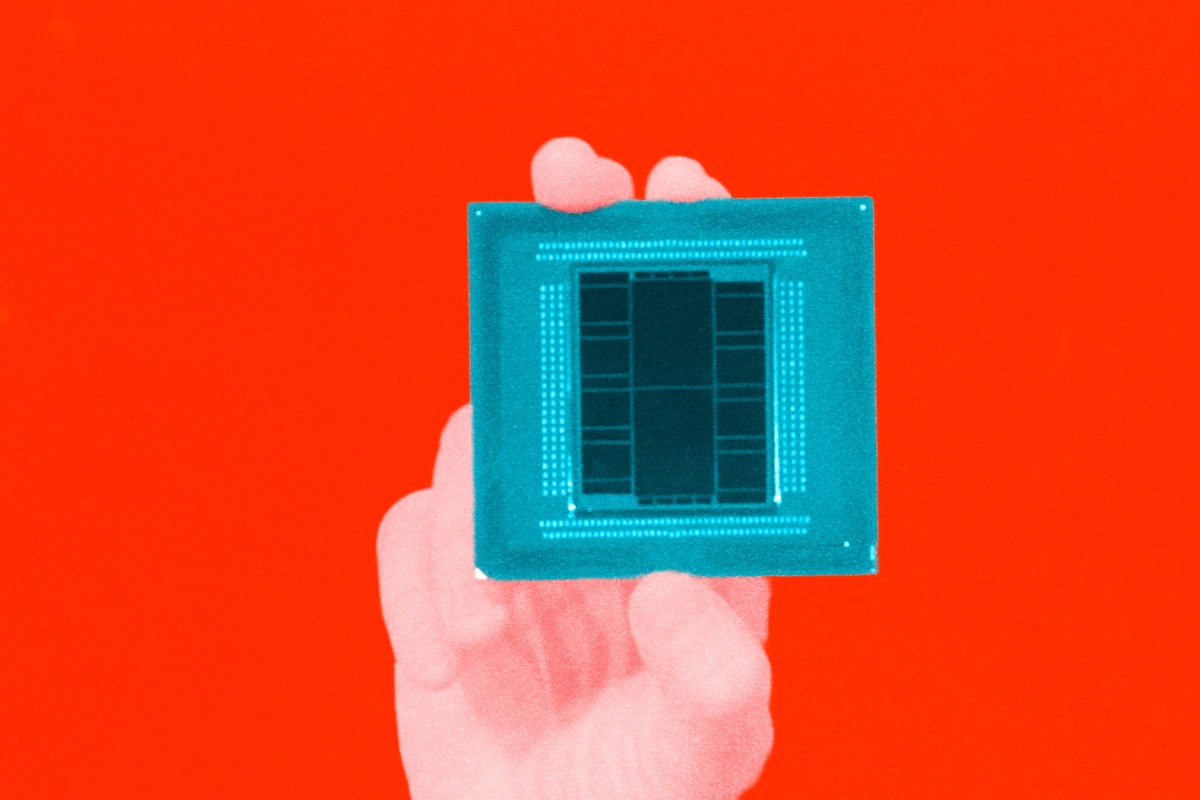
AMD held its Advancing AI event in San Francisco this week and did not come to talk about your gaming PC. The headliners: sixth-generation EPYC "Venice" server processors, the Instinct MI455X accelerator, a full rack-scale system called Helios, and a software layer confusingly named ROCm.ai[1]. The framing was pure 2026, all agentic AI and a projected $2 trillion market by 2030. Underneath the vocabulary, though, AMD shipped its most serious hardware argument in years, so let us separate the silicon from the slogans.
Venice is the Zen 6 server part, and the top configuration is a genuine escalation: up to 256 cores and 512 threads on a single socket in the dense Zen 6C variant, while a 96-core version with full-fat cores boosts to 5.0 GHz. AMD claims around 20 percent more performance per core over the previous generation, memory moves to 16 channels of DDR5-8000 with second-generation MRDIMM support, and I/O jumps to PCIe Gen 6 with up to 160 lanes in two-socket systems[5]. There are four variants to keep straight: the flagship SP7 platform shipping late this year, a smaller SP8, a 3D V-Cache model in 2027, and a low-power "Verano" for AI host nodes in late 2027[1]. What there is not: a price list, a complete SKU table, or independent benchmarks. Phoronix politely called it a soft launch[5], which is the professional term for a keynote with excellent slides.
The rack is the pitch
The MI455X is AMD's first 2nm accelerator and carries 432 GB of HBM4 memory, half again as much as the MI355X, with claimed peaks of up to four times the low-precision throughput and 34 times the token throughput of its predecessor. Bolt 72 of them together with 18 Venice CPUs and Pensando networking and you get Helios: 2.9 exaflops of FP4 compute, 31 TB of HBM4, and 1.7 petabytes per second of memory bandwidth in a single rack[3]. The word "bolt" is doing dishonest work in that sentence, because the backplane is the actual battleground. Nvidia's NVL72 moat was never 72 GPUs in a cabinet; it is NVLink, the copper spine that lets them behave like one enormous chip, and PCIe Gen 6 is nowhere near fast enough to substitute. AMD's answer is UALink, the open scale-up standard it organized with Broadcom, Cisco, and Intel, with the Pensando gear carrying rack-to-rack traffic over Ultra Ethernet[3]. The backplane is also a plumbing project: 72 accelerators and 18 server CPUs put a single rack well north of 100 kilowatts, and no amount of moving air handles that. Helios is liquid-cooled or it is a bonfire, which means it lives in purpose-built facilities with water loops, not in the corner of an enterprise server room.
AMD's comparison slide claims 15 percent more peak compute and 50 percent more memory capacity than Nvidia's Vera Rubin NVL72, plus up to 30 percent more tokens per dollar[2]. Tokens per dollar is vendor math, and vendor math always picks its own workload. What is not vendor math is the customer list: OpenAI brings Helios online in the fourth quarter, Anthropic committed to up to two gigawatts of capacity and is using Claude to optimize ROCm itself, and Meta, Microsoft, and Oracle all bought in[3]. Hold that Anthropic number up to the light before nodding along, because two gigawatts is roughly the output of two full-size nuclear reactors. Nobody takes delivery of that; it is a multi-year buildout across multiple purpose-built data centers, and that is exactly why it matters more than any benchmark slide. AMD is signing utility-scale, years-long contracts, not one-off rack sales. Companies do not commit gigawatts to a rounding error.
Software, the permanent caveat
ROCm.ai, despite the name, is not a new version of ROCm. It is a layer on top: a command-line tool, "Skills" plug-ins that turn coding assistants like Claude, Codex, Cursor, and Gemini into what AMD calls ROCm superusers, and Hyperloom, an open-source agentic system that supposedly compresses weeks of inference optimization into hours[4]. AMD claims an average 3.3x inference improvement over plain ROCm 7.0[7]. The software story matters more here than any transistor count. Nvidia's moat was never the silicon; it is a decade of CUDA muscle memory across the entire industry. AMD has promised to fix its software story for roughly as long, and teaching the AI tools engineers already use to speak ROCm is at least a smarter bet than another documentation portal. Keep the cynicism calibrated, though: a coding agent that writes your ROCm scripts does nothing about the layer where AMD's software reputation actually went to die, the kernel panics, the PyTorch builds that refuse to compile, the drivers that fall over under sustained load. The top of the stack getting friendlier is welcome. The bare metal still has to prove it stays upright when 72 GPUs lean on it at once. ROCm.ai ships in August. I will believe the 3.3x when somebody outside AMD's payroll reproduces it.
One thread worth pulling before the applause dies down. Every chip announced on that stage runs on HBM, the stacked high-bandwidth memory that earns memory makers roughly twice the margin of ordinary DRAM[9]. Two gigawatts for Anthropic here, a gigawatt campus there, and each commitment quietly consumes fab capacity that never comes back. When people ask why desktop memory still costs what it does[10], this keynote is the answer wearing a lanyard. The AI buildout is not competing with your next PC for chips in the abstract. It is bidding for the same wafers, and it is not losing.
The roadmap extends the point. Zen 7 "Florence" is confirmed for 2028 with new ACE vector extensions developed with Intel, of all companies, and Zen 8 "Ravenna" already has a name and a 2030 window[8]. That is the real pattern of the week: AMD no longer behaves like the cheaper alternative pacing Intel. It behaves like the second pole of a duopoly, pacing Nvidia in units of gigawatts. Venice looks like a grand slam on paper. Paper is, for the next two quarters, where it lives.
Sources
- AAI 2026: 6th Gen AMD EPYC Server CPUs Power the Agentic Data CenterAMD Newsroom
- AAI 2026: AMD Launches AMD Instinct MI400 Series GPUs for Frontier AI, HPCAMD Newsroom
- AAI 2026: AMD Launches AMD Helios Rackscale Solution for Frontier AIAMD Newsroom
- AAI 2026: AMD ROCm.ai Accelerates AI Development Across AMD PlatformsAMD Newsroom
- AMD EPYC 9006 Venice Announced & Looks Poised To Be A Grand SlamPhoronix
- AMD Launches Instinct MI455X, Helios AI RackPhoronix
- AMD Announces ROCm.AI As AI-Driven Platform For DevelopersPhoronix
- AMD EPYC Zen 7 "Florence" Confirmed With ACE, Next-Gen MemoryPhoronix
- HBM vs commodity DRAM margin estimate (~60% vs ~40%)indmoney (citing TrendForce / Bernstein estimates)
- The RAM Shortage Is Worse Than You Think, and Nowhere Near Overcasually.onl