Microsoft Won't Stop Making Insane Claims About New States Of Matter.
For the second time in a decade, Microsoft says it has built a qubit from a brand-new state of matter, and for the second time independent physicists say the data does not show it. The pattern deserves more attention.
There is a particular kind of science story that should make you slow down rather than speed up: the breakthrough that arrives precisely on a corporate marketing schedule. Microsoft has now done this more than once, announcing that it has built a quantum bit out of a brand-new state of matter. Each time the claim is dressed for maximum reach, and each time independent physicists go to the data and come back saying the same thing. It does not show what the announcement says it shows. At this point the repetition is not a run of bad luck. It is a method, and the thing being reliably manufactured is not a qubit but a headline[1].
The dream is real, and it deserves a fair hearing. Microsoft is chasing a topological qubit, one that would store information not in a single fragile particle but spread across a state of matter assembled from elusive things called Majorana zero modes. If it worked, the qubit would be shielded from noise at the level of physics itself, which is the single hardest problem in quantum computing. That is a prize worth a decade of effort. It is also a prize that makes everyone, including the people chasing it, very eager to believe they have already arrived.
This is not the first time the arrival has been announced. In 2018 a Microsoft-funded team published a celebrated paper claiming to have seen the telltale signature of these modes. An outside physicist asked for the raw data the paper had left out and found that measurements contradicting the headline had simply been deleted from the graphs. Nature retracted the paper in 2021[2], and the authors apologized for what an investigation called insufficient scientific rigour[3]. A second related paper was pulled the next year. The lesson Microsoft drew was reasonable on its face: build a tool to take the fallible humans out of the loop.
The tool that was supposed to fix it
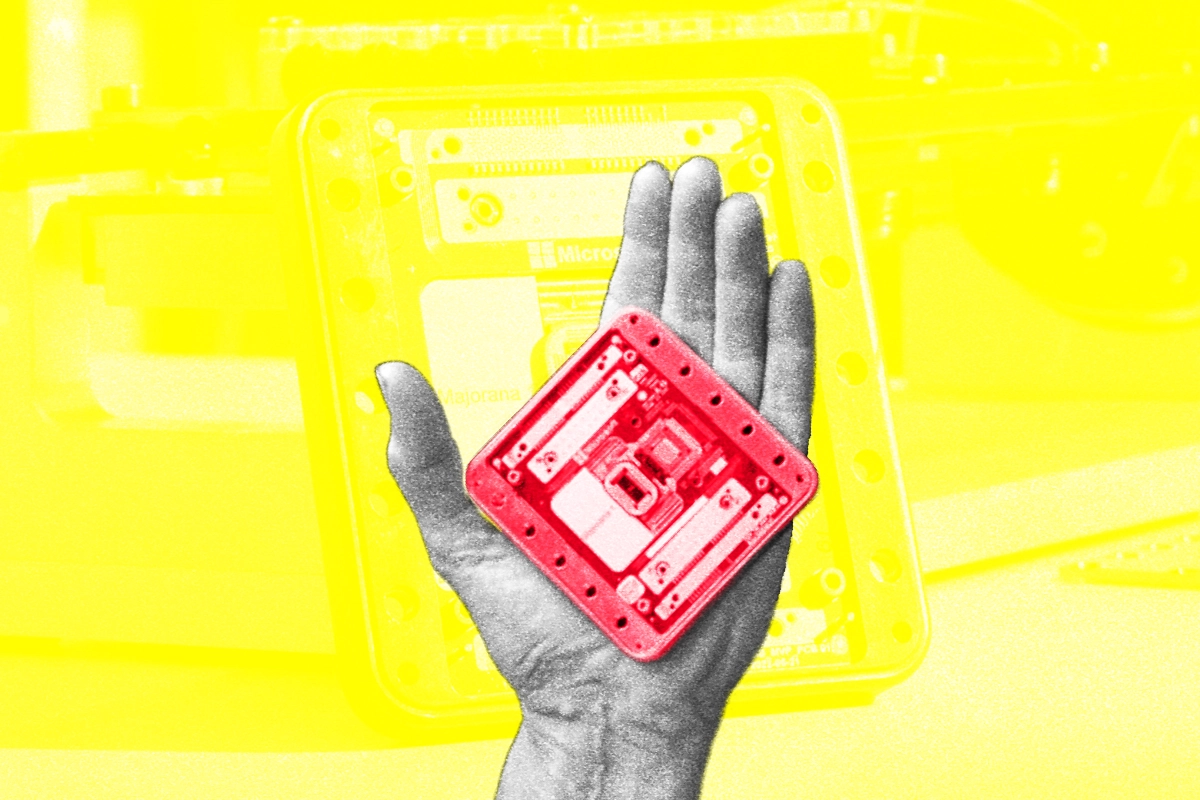
That tool was a piece of software, the Topological Gap Protocol, meant to scan the messy experimental data and return a yes-or-no verdict on whether the new state of matter was present, with no room left for wishful thinking. In February 2025 it underwrote the headline. Microsoft unveiled the Majorana 1 chip and described it, in its marketing, as the first processor powered by a topological core and proof of a new state of matter that had only ever existed in theory[4]. The peer-reviewed paper underneath was far more modest, and the journal made sure everyone knew it: Nature took the unusual step of attaching a note stating plainly that the results were not evidence for the Majorana modes being claimed.
Physicists noticed the gap between the paper and the press release at once. The device, several pointed out, demonstrated a way to take a reading, not a working qubit anyone could actually control[5]. Something might be in there, the careful version went, but they cannot steer it, and a thing you cannot steer is not yet a computer.
Then, in 2026, the supposedly incorruptible software was audited. Henry Legg, a theoretical physicist at the University of St Andrews, went through Microsoft's released code and raw data and published a critique in Nature. As AI Weekly reported, what he found was not subtle. The program contained basic coding mistakes, including one that scrambled the data by reordering it the wrong way. More damning, it carried a filter hard-coded to display only the single most favorable patch of a device and hide everything else, which is the automated version of the exact cherry-picking the tool was built to prevent. He also showed the verdict could flip from yes to no depending on an arbitrary choice about where to crop the graph. Loosen the definition of success a little, search a big enough field of noise, and you will always find a shape, the way people find a face in a piece of toast.
Microsoft's response is its own kind of tell. The company did not really dispute that the code did these things. It recast them as minor bugs, and recast the tool itself, sold for years as an objective referee, as merely a practical aid for tuning chips. The head of the quantum effort compared criticizing the software to doubting that airplanes fly because you dislike one dial on the dashboard, and waved at confidential evaluations by a government funding agency as evidence the work was sound. When you are caught hiding data, the honest move is to correct the record. Microsoft instead moved the goalposts and hid behind a classified shield no outsider can inspect. That is not the conduct of a company that wants to be right. It is the conduct of a company that wants to keep the headline.
Right on cue, a bigger announcement
Here is where the pattern closes the loop. Weeks before that critique appeared, Microsoft announced Majorana 2, a next-generation chip promising a thousandfold improvement, a new material discovered with the help of AI, and a headline qubit lifetime of twenty seconds. The twenty seconds is real, but it measures the wrong thing. It is how long the chip holds an ordinary, classical state, not how long it holds the fragile quantum superposition that makes a qubit useful at all. As Legg put it, a classical bit has a lifetime of years, and that does not make it a good qubit. The measurements that would actually demonstrate quantum behavior were left, in the paper's own words, to future work.
Lay the events end to end and this stops looking like science colliding with hype and starts looking like a playbook. A breakthrough is announced with a full marketing apparatus behind it. Outsiders find the evidence was massaged. A quiet correction lands somewhere almost no one will read it. And right on schedule, a larger, shinier announcement arrives to bury the bad news before it can travel. You do not have to prove a single measurement was faked to see the shape of it. The marketing never needed the physics to be real. It only needed the headline to land before the correction did, and it has now done exactly that twice.
That works because there are two audiences and two stories. The hedged, careful version goes into the journal, where the caveats sit in the margins and the editors have to bolt on a disclaimer by hand. The triumphant version goes into the press release, where no caveat survives. Almost everyone meets only the second one, and by the time a physicist publishes the rebuttal, the headline has already done its job on investors, partners, recruits, and the public.
There is something rotten at the core of this
The internal failure it points to is the part that should genuinely alarm people. A campaign like this does not escape a lab by accident. Somebody wrote the words new state of matter over a result the journal had already flagged as no such thing. Somebody approved those words. They passed through communications, through legal, through executive sign-off, and went out as a polished global rollout, and at no step did anyone with the authority to stop it decide that being wrong on purpose was a problem worth raising. A functioning company has a dozen people in that chain who can pull the cord. Microsoft shipped it anyway, and then shipped it again. You do not get there without something being badly wrong in the culture doing the signing off.
And the damage does not stay inside Microsoft. Every time one of the largest companies on Earth launders marketing through Nature, it spends down a kind of public trust that took a century to build and that no quarterly number will replace. People already struggle to know which science to believe, and corporations that treat peer review as a stage prop are a large part of why, degrading a shared resource for a temporary edge. This is also not the only corner where the company's internal compass looks broken. The same instinct, take the expedient path and manage the optics later, runs through its long habit of leaning on outside security researchers while dragging its feet on paying them, the backdrop to our reporting on the Nightmare-Eclipse zero-day streak. Different department, same rot.
None of this means the topological qubit is impossible, and the physics deserves to be said plainly, because it deserves better than the people marketing it. The idea is beautiful, and a real version would earn every superlative. But beauty is not evidence, a roadmap is not a result, and a press release is not a discovery. What would count is boring and specific: a qubit you can control along more than one axis, measured the same way more than once, on more than one device, with no software quietly choosing which data you are allowed to see. Until that exists, the honest way to read a Microsoft quantum headline is as what the pattern says it is. Not a dispatch from the frontier of physics, but an advertisement, and one the company has taught us to distrust the hard way, one buried caveat at a time.
Sources
- The Pursuit and Controversies of Quantum ComputingUniversity of Auckland Scientific
- Retraction Note: Quantized Majorana conductanceNature
- Authors retract Nature Majorana paper, apologize for 'insufficient scientific rigour'Retraction Watch
- Majorana 1Wikipedia
- Microsoft's claim of a working topological qubit sparks skepticism among physicistsReddit (r/Physics)
- Microsoft Majorana Quantum Claim Challenged in Nature CritiqueAI Weekly
- The Security Nightmare That Eclipsed All Otherscasually.onl