How a Deep-Sea Giant Goes Five Years Without a Meal
The supergiant isopod is internet-famous for skipping meals for years at a time. A new study finally explains the trick: a stomach that fills two-thirds of its body, an engine idled almost to a stop, and maybe a gene it borrowed from bacteria.
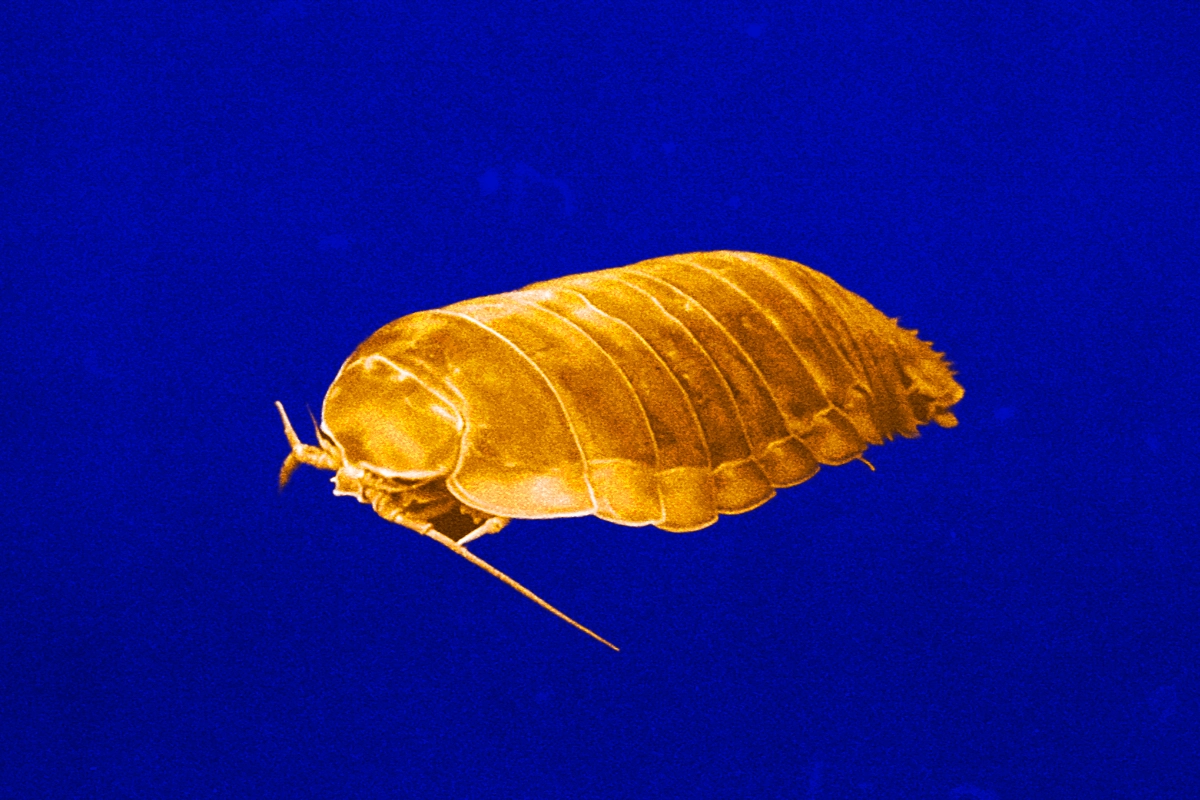
The supergiant isopod is one of those animals the internet adopted years ago: a deep-sea crustacean that can reach the size of a small dog, all armor plates and too many legs, like a woodlouse designed by a committee with a grudge. Its main claim to fame is going years without eating, including one captive individual that reportedly refused food for more than five years before it died[1]. A team at the Institute of Oceanology under the Chinese Academy of Sciences, publishing in the journal Cell, has now worked out how the animal pulls this off, and the answer turns out to be a two-part system rather than a single trick[2].
Why the deep sea starves you
To see why this is impressive, you have to picture the environment. On the deep-sea floor there is no sunlight and almost no local food production. Most of what arrives falls from far above as 'marine snow,' the slow drift of dead plankton and waste, punctuated only rarely by something large, a dead fish or a whale, hitting the bottom[3]. An animal down there lives feast-to-famine on a schedule it does not control, and famine is the default setting. Survival means either burning energy to hunt for food that is not there, or evolving to need almost none at all.
A stomach built for the binge
The first half of the isopod's answer is storage. The researchers found that its stomach takes up roughly two-thirds of its entire body, a cavernous larder far larger than anything its shallow-water relatives carry[2]. When a windfall does arrive, the animal can gorge and bank an enormous amount of it at once, then draw that reserve down slowly over the long stretch until the next meal[4]. It is the biological version of buying in bulk because you do not know when the store will reopen.
The frugal engine
The second half is metabolism. The team reports that the isopod runs at an extremely low basal metabolic rate, the baseline energy cost of simply staying alive[2]. Turn that dial down far enough and a full stomach can last an implausibly long time, because the body is barely spending. Big cold-water animals already tend toward slow metabolisms, but the study frames this as the other half of a deliberate pairing: a huge tank and a very frugal engine, evolved together to fit a place where food is both rare and unpredictable[5].
Borrowed from bacteria
The paper's most surprising claim, and one that deserves a healthy dose of scientific skepticism, involves a gene called ND1 that is tied to suppressing energy metabolism in the cold. The researchers suggest that this gene appears to have been transferred into the isopod's genome from bacteria, an example of horizontal gene transfer, where DNA moves between unrelated organisms instead of being passed down from parents[4]. Horizontal transfer into an animal is unusual, and the sort of finding that invites close scrutiny before anyone treats it as settled. But if it holds up, it means part of this creature's talent for near-starvation was, in a sense, borrowed from microbes[2].
A few caveats are worth noting. The famous five-year figure is a reported maximum from captivity, not a routine, and captive animals behave differently from wild ones[1]. And as with almost every metabolism study, the write-ups reach quickly for human applications: longevity research, obesity treatment, better aquaculture[2]. Treat those as the hopeful coda they are, not the result. The actual finding is cleaner, and honestly more satisfying than any of them. A very large animal, in a place with almost nothing to eat, gets by on a giant pantry and an engine idled almost to a stop, with maybe an assist from a gene it picked up from bacteria.
Sources
- This Strange Sea Creature Can Survive Five Years Without Food, Scientists Finally Know WhySciTechDaily
- Researchers reveal how supergiant deep-sea isopods survive years without foodEurekAlert! (IOCAS)
- Deep-sea supergiant isopods last years without food by using a two-part survival systemPhys.org
- Researchers Reveal How Supergiant Deep-Sea Isopods Survive Years Without FoodChinese Academy of Sciences
- How These Supergiant Sea Creatures Survive More Than 5 Years Without EatingNautilus